The Pakistan Standards and Quality Control Authority (PSQCA) is the national authority responsible for standards, conformity assessment, and quality control in Pakistan. It operates under the PSQCA Act, 1996 and works to ensure that products covered by applicable mandatory standards meet the required specifications.
For products included in Pakistan’s compulsory standards/conformity assessment requirements, manufacturers and relevant businesses may need to obtain a PSQCA Certification Mark (CM) Licence before marketing or manufacturing the product as required by applicable regulations.
PSQCA maintains an official list of compulsory products, which includes various food products, electrical products, construction materials, consumer products, and other categories. Examples include bottled drinking water, cooking oil, biscuits, shampoo, toilet soap, toothpaste, steel bars, gas appliances, and other products.
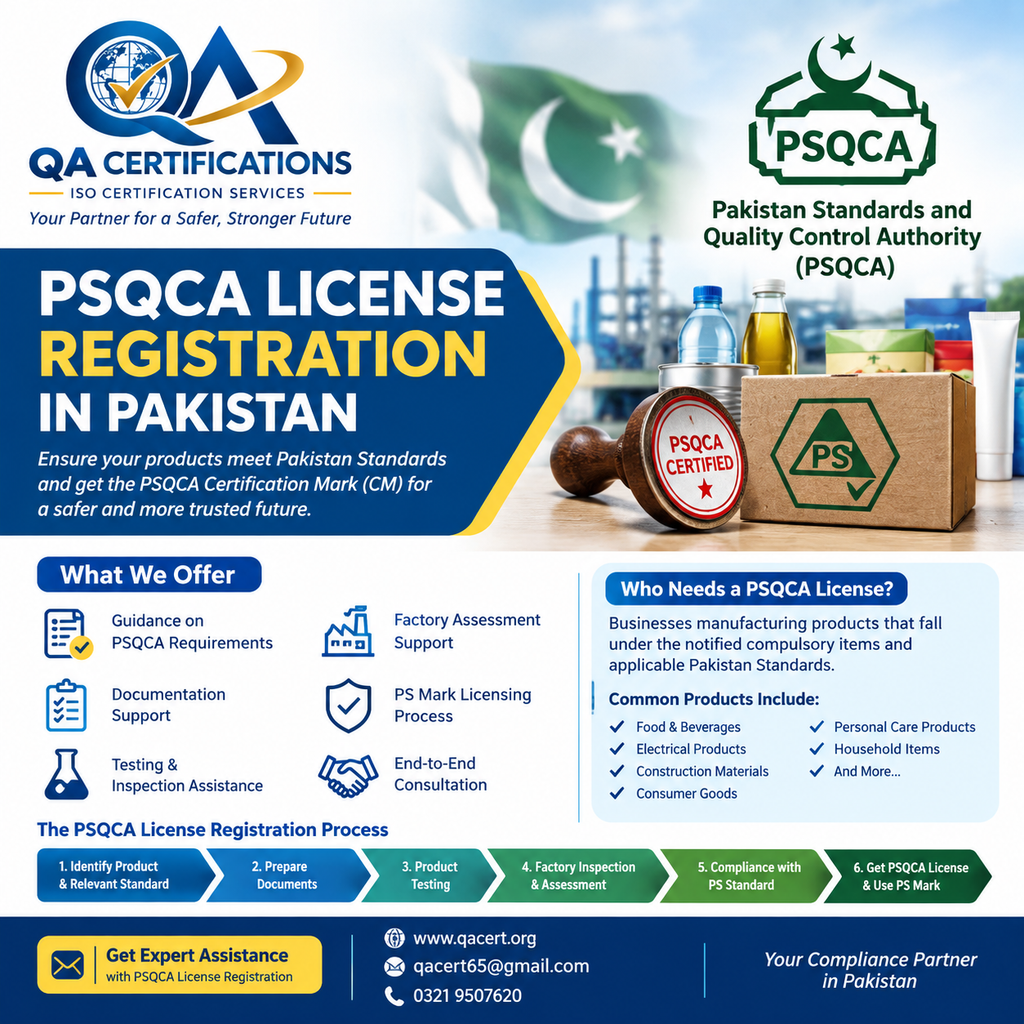
Who Needs a PSQCA License in Pakistan?
PSQCA licensing is particularly relevant to businesses manufacturing products that fall under the notified compulsory items and applicable Pakistan Standards.
Before applying, it is important to determine:
- Whether your product is included in the compulsory PSQCA list
- Which Pakistan Standard (PS) applies to your product
- Whether product testing is required
- Whether factory inspection or assessment is applicable
- What quality-control arrangements are required
- Which documents and application forms need to be submitted
The requirements can vary according to the product and applicable standard. PSQCA’s official information includes separate conformity-assessment procedures and lists of compulsory products.
PSQCA License Registration Process in Pakistan
The general process may involve the following steps:
1. Product and Standard Identification
First, identify the exact product for which the licence is required and determine the relevant Pakistan Standard Specification.
PSQCA maintains product standards across areas such as agriculture and food, chemical products, electrical and electronics, mechanical products, textiles, healthcare, halal standards, and other technical fields.
2. Preparation of Documents
The applicant needs to prepare the information and documentation required for the applicable PSQCA conformity-assessment process.
The PSQCA application documentation includes information such as the applicant’s registered office, business address, responsible quality-system personnel, manufacturing location, product details, applicable rules, and relevant standards. (PSQCA)
Depending on the product and application, additional technical or quality-related documents may be required.
3. Product Testing
Testing is an important part of conformity assessment for applicable products.
PSQCA’s licence requirements state that organizations must ensure appropriate testing of products and, where required, testing through an accredited laboratory to demonstrate conformity with the applicable quality requirements. (PSQCA)
4. Factory Assessment and Inspection
Where applicable, PSQCA may assess the manufacturing facility and quality-control arrangements.
The PSQCA licence requirements include provisions for inspection, access to necessary facilities, and providing information and production or quality records when required. (PSQCA)
5. Compliance with the Relevant Pakistan Standard
The product must comply with the applicable Pakistan Standard and relevant PSQCA requirements.
Businesses should therefore establish suitable quality-control procedures and maintain appropriate production and testing records.
6. PSQCA Licence and Certification Mark
After the applicable assessment and requirements have been successfully completed, the relevant licence may be granted according to the applicable PSQCA scheme.
Businesses should use the PS Mark/Conformity Mark only in accordance with the conditions of the applicable licence and PSQCA requirements.
Documents Required for PSQCA Registration
The exact documentation depends on the product and applicable conformity-assessment scheme. Common information may include:
- Company/business registration details
- Applicant’s name and registered address
- Manufacturing/factory address
- Product name and description
- Applicable Pakistan Standard
- Product specifications
- Quality-control information
- Testing reports, where applicable
- Details of quality-control personnel
- Manufacturing process information
- Application forms prescribed by PSQCA
- Other technical documents required for the specific product
PSQCA provides official application forms for certification marks licences, licence applications, self-evaluation/declaration, and licence renewal.
Why is PSQCA Licensing Important?
For products subject to mandatory PSQCA requirements, obtaining the applicable licence helps businesses demonstrate conformity with the relevant Pakistan Standard.
PSQCA’s conformity-assessment framework is intended to support quality control and compliance with applicable national standards. The authority also provides mechanisms for certification-mark licensing, product certification, enforcement, and follow-up of non-conformances.
For manufacturers, proper compliance can also help establish documented quality-control practices and provide evidence that the product has been assessed against the applicable requirements.
PSQCA License vs ISO Certification
PSQCA licensing and ISO certification are not the same thing.
PSQCA licensing is related to product conformity and applicable Pakistan Standards under the PSQCA regulatory framework.
ISO certification, such as ISO 9001, generally concerns a management system and evaluates whether an organization operates a management system against the requirements of a particular ISO standard.
Therefore, a business should first identify its product-specific regulatory and conformity requirements and then determine whether additional management-system certifications are useful or required for its operations or customers.
Get Help with PSQCA License Registration in Pakistan
Understanding the applicable Pakistan Standard, compulsory-product requirements, testing requirements, documentation, and assessment process can make PSQCA registration easier to manage.
QA Certification provides professional guidance for businesses seeking assistance with certification and compliance requirements in Pakistan. Our team can help you understand the applicable requirements, prepare documentation, coordinate relevant processes, and guide you through the certification journey.
Contact QA Certification
Website: www.qacert.org
Email: qacert65@gmail.com
Phone: 0321 9507620
Need assistance with PSQCA License Registration in Pakistan? Contact QA Certification today to discuss your product and certification requirements.
Note: PSQCA requirements can vary by product and may be updated through official notifications, standards, and regulatory requirements. Businesses should verify the current requirements applicable to their specific product before submitting an application.